Universitas Pelita Harapan Biology Study Program continues to demonstrate its strong commitment to environmental sustainability through innovative research led by its lecturers and students. In response to the growing problem of textile wastewater pollution, the research team led by Ricky Handersen and Joan Christie Wijaya with the help of lecturers from UPH, Bambang Kiranadi, Melanie Cornelia, and Reinhard Pinontoan, has successfully developed an alternative biological approach to help remove synthetic dyes from water.
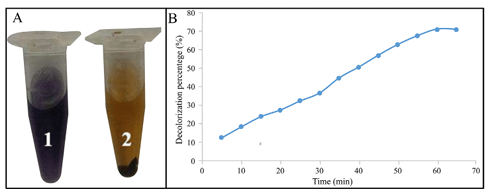
Decolorization potential of A. oryzae.
A. 1: negative control 2: After incubation 60 minutes. B. Graph of decolorization percentage after a period of time (5 - 65 minutes)
The study explored the use of Aspergillus oryzae, a beneficial fungus isolated from miso, a traditional fermented food. The researchers first isolated and characterized the microorganism based on its morphology before testing its ability to decolorize commercial blue textile dye. To ensure maximum efficiency, the team applied Response Surface Methodology (RSM), a statistical tool that help determines optimal conditions for the process. Under ideal conditions, which was 33°C, pH 6.2, dye concentration of 200 ppm, and six days of incubation, the fungus achieved an impressive 92% decolorization rate, demonstrating its high potential as an eco-friendly treatment agent for dye-contaminated wastewater.
Eco-Friendly Solution for Textile Waste Pollution: A Research by Biology Study Program
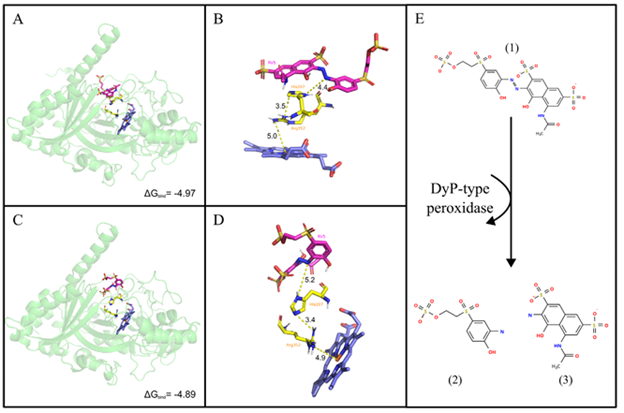
To further understand how the process works at the molecular level, the research team also employed molecular docking analysis. The results revealed that peroxidase enzymes produced by Aspergillus oryzae play a crucial role in breaking down dye molecules by oxidizing azo bonds, which are responsible for the color in many textile dyes. This finding provides valuable insight into the enzymatic degradation mechanism and supports the potential application of this method in sustainable wastewater treatment. Through this research, the Biology Study Program reinforces its contribution to environmental protection while advancing scientific innovation for a greener future.